C18 · galaxy
NGC 185
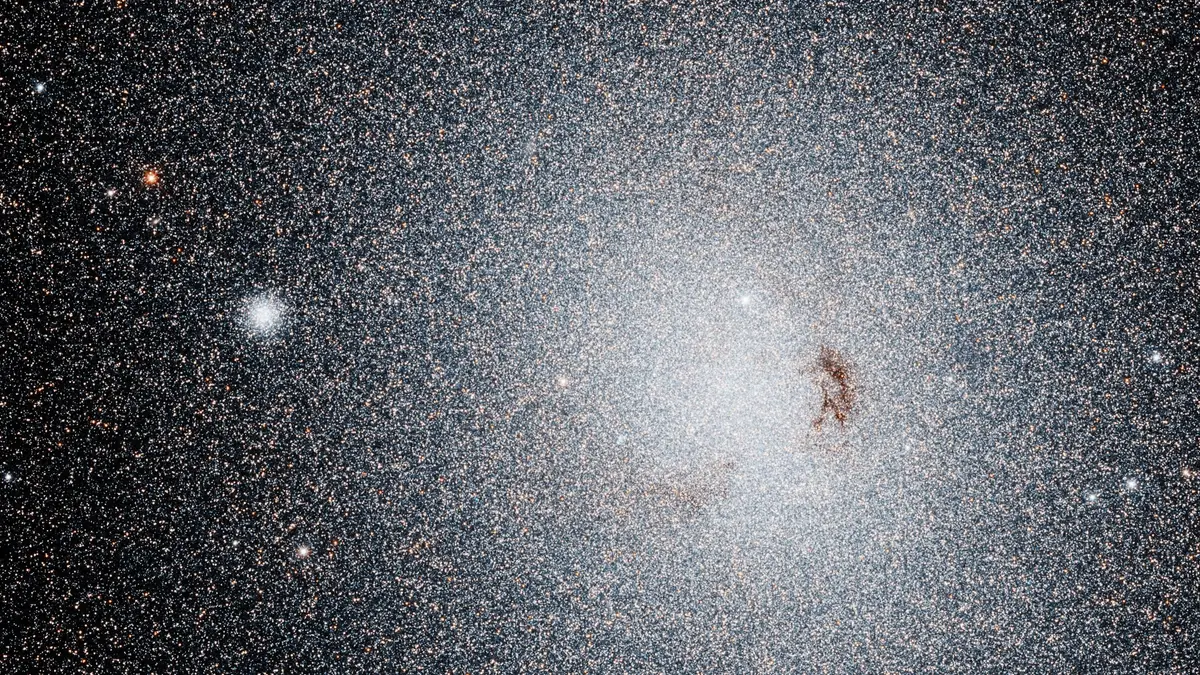
NGC 185 is a dwarf spheroidal galaxy located 2.08 million light-years from Earth, appearing in the constellation Cassiopeia.
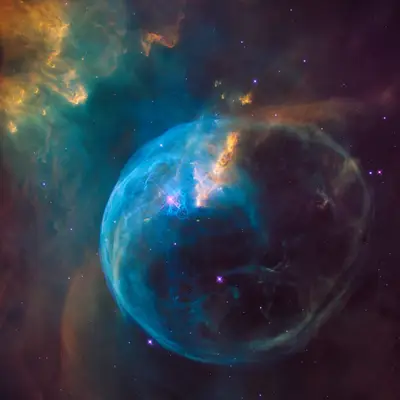
Image: NASA Hubble Space Telescope. CC BY 2.0, via Wikimedia Commons.
Identity & coordinates
Identification
- Primary designation
- C18
- All designations
- C18 · NGC 185
- Object type
- Galaxy
- Constellation
- Cassiopeia
- Best viewing
- Autumn · Winter
Coordinates & physical
- Right ascension (J2000)
- 00h 38m 57s
- Declination (J2000)
- +48° 20' 14"
- Apparent magnitude (V)
- —
- Distance
- —
- Redshift (z)
- -0.000674
Visibility tonight
The science
NGC 185 is a dwarf spheroidal galaxy located 2.08 million light-years from Earth, appearing in the constellation Cassiopeia. It is a member of the Local Group, and is a satellite of the Andromeda Galaxy (M31). NGC 185 was discovered by William Herschel on November 30, 1787, and he cataloged it "H II.707". John Herschel observed the object again in 1833 when he cataloged it as "h 35", and then in 1864 when he cataloged it as "GC 90" within his General Catalogue of Nebulae and Clusters. NGC 185 was first photographed between 1898 and 1900 by James Edward Keeler with the Crossley Reflector of Lick Observatory. Unlike most dwarf elliptical galaxies, NGC 185 contains young stellar clusters, and star formation proceeded at a low rate until the recent past. NGC 185 has an active galactic nucleus (AGN) and is usually classified as a Type II Seyfert galaxy, though its status as a Seyfert is questioned. It is possibly the closest Seyfert galaxy to Earth, and is the only known Seyfert in the Local Group.
Summary adapted from Wikipedia · CC-BY-SA-4.0
References
- SIMBAD Not resolved
- NED Fetched May 8, 2026 View in NED ↗
- Wikipedia Fetched May 8, 2026 Read full article ↗
Wikipedia title resolved via designation — fell back to an alternate catalog designation.
1 merge conflict resolved
- coordinates: SIMBAD missing → NED used