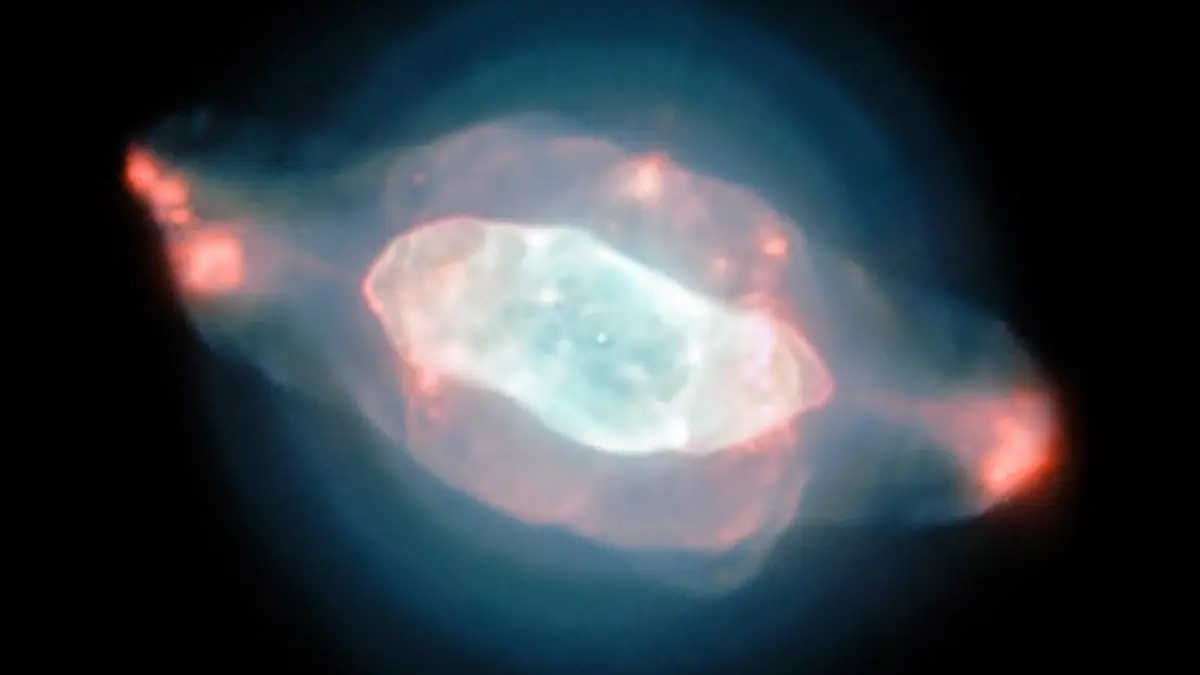
C55 · planetary nebula
Saturn Nebula
The Saturn Nebula is a planetary nebula in the constellation Aquarius.
Identity & coordinates
Identification
- Primary designation
- C55
- All designations
- C55 · NGC 7009 · Saturn Nebula
- Object type
- Planetary Nebula
- Constellation
- Aquarius
- Best viewing
- Autumn
Coordinates & physical
- Right ascension (J2000)
- 21h 04m 10s
- Declination (J2000)
- −11° 21' 48"
- Apparent magnitude (V)
- —
- Distance
- —
Visibility tonight
The science
The Saturn Nebula is a planetary nebula in the constellation Aquarius. It appears as a greenish-yellowish hue in a small amateur telescope. It was discovered by William Herschel on September 7, 1782, using a telescope of his own design in the garden at his home in Datchet, England, and was one of his earliest discoveries in his sky survey. The nebula was originally a low-mass star that ejected its layers into space, forming the nebula. The central star is now a bright white dwarf star of apparent magnitude 11.5. The Saturn Nebula gets its name from its superficial resemblance to the planet Saturn with its rings nearly edge-on to the observer. It was so named by Lord Rosse in the 1840s, when telescopes had improved to the point that its Saturn-like shape could be discerned. William Henry Smyth said that the Saturn Nebula was one of Struve's nine "Rare Celestial Objects".
Summary adapted from Wikipedia · CC-BY-SA-4.0
References
- SIMBAD Not resolved
- NED Fetched May 8, 2026 View in NED ↗
- Wikipedia Fetched May 8, 2026 Read full article ↗
1 merge conflict resolved
- coordinates: SIMBAD missing → NED used