C6 · planetary nebula
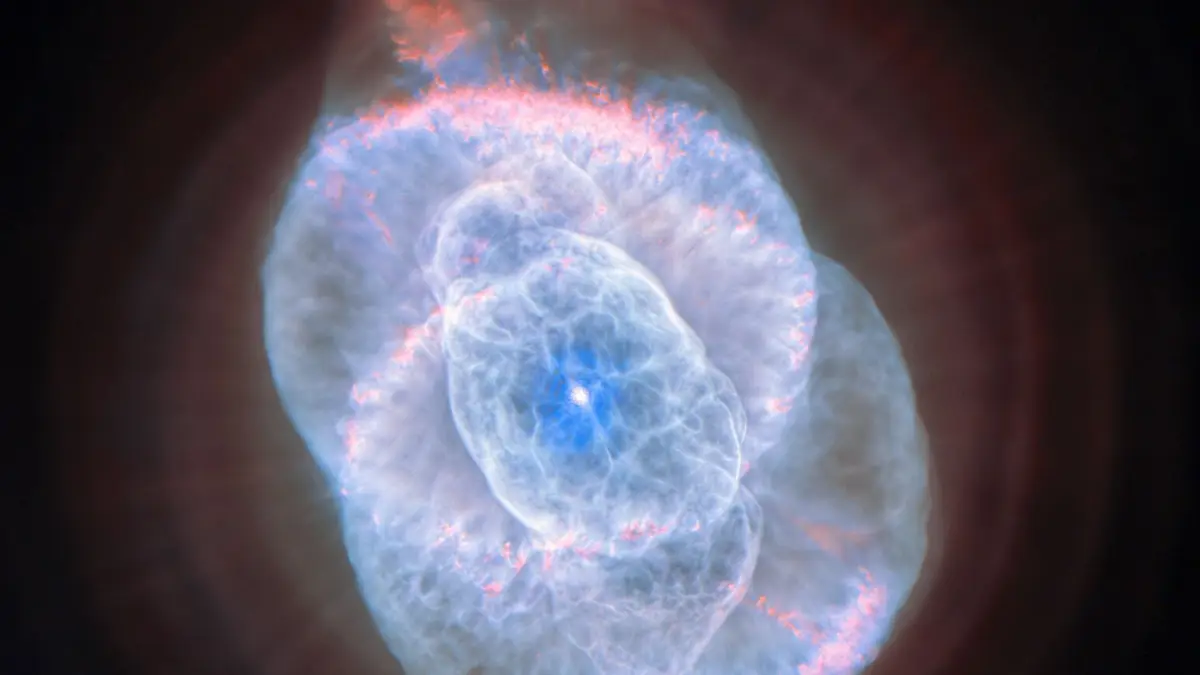
Cat's Eye Nebula
The Cat's Eye Nebula is a planetary nebula in the northern constellation of Draco, discovered by William Herschel on February 15, 1786.
Image: ESA/Hubble & NASA, Z. Tsvetanov. CC BY 4.0, via Wikimedia Commons.
Identity & coordinates
Identification
- Primary designation
- C6
- All designations
- C6 · NGC 6543 · Cat's Eye Nebula
- Object type
- Planetary Nebula
- Constellation
- Draco
- Best viewing
- Spring · Summer
Coordinates & physical
- Right ascension (J2000)
- 17h 58m 33s
- Declination (J2000)
- +66° 37' 58"
- Apparent magnitude (V)
- —
- Distance
- —
- Redshift (z)
- 0.042000
Visibility tonight
The science
The Cat's Eye Nebula is a planetary nebula in the northern constellation of Draco, discovered by William Herschel on February 15, 1786. It was the first planetary nebula whose spectrum was investigated by the English amateur astronomer William Huggins, demonstrating that planetary nebulae were gaseous and not stellar in nature. Structurally, the object has had high-resolution images by the Hubble Space Telescope revealing knots, jets, bubbles and complex arcs, being illuminated by the central hot planetary nebula nucleus (PNN).
It is a well-studied object that has been observed from radio to X-ray wavelengths. At the centre of the Cat's Eye Nebula is a dying Wolf–Rayet star, the sort of which can be seen in the Webb Telescope's image of WR 124. The Cat's Eye Nebula's central star shines at magnitude +11.4. Hubble Space Telescope images show a sort of dart board pattern of concentric rings emanating outwards from the centre.
Summary adapted from Wikipedia · CC-BY-SA-4.0
![C3-class Solar Flare Erupts on Sept. 8, 2010 [Full Disk]](https://pythongames.blob.core.windows.net/wonders/c3/card-400.webp)
References
- SIMBAD Not resolved
- NED Fetched May 8, 2026 View in NED ↗
- Wikipedia Fetched May 8, 2026 Read full article ↗
1 merge conflict resolved
- coordinates: SIMBAD missing → NED used