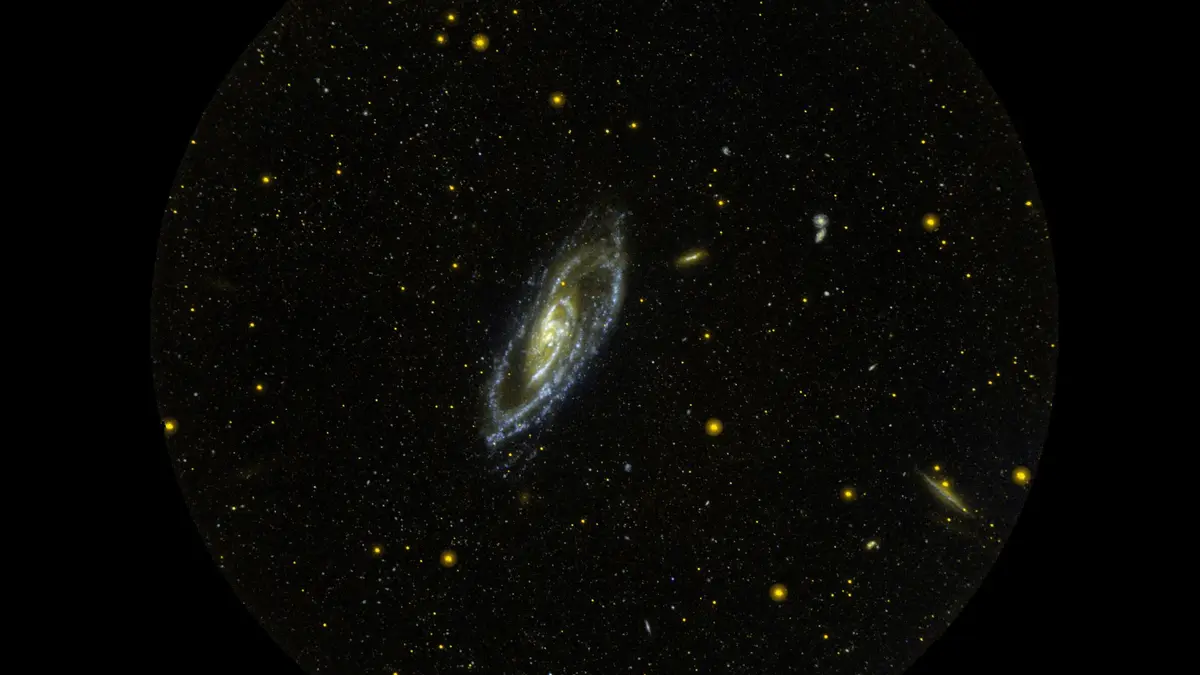
M106 · galaxy
Messier 106
Messier 106 is an intermediate spiral galaxy in the constellation Canes Venatici.
Identity & coordinates
Identification
- Primary designation
- M106
- All designations
- M106 · NGC 4258
- Object type
- Galaxy
- Constellation
- Canes Venatici
- Best viewing
- Spring
Coordinates & physical
- Right ascension (J2000)
- 12h 18m 57s
- Declination (J2000)
- +47° 18' 14"
- Apparent magnitude (V)
- —
- Distance
- —
- Redshift (z)
- 0.001538
Visibility tonight
The science
Messier 106 is an intermediate spiral galaxy in the constellation Canes Venatici. It was discovered by Pierre Méchain in 1781. M106 is at a distance of about 22 to 25 million light-years away from Earth. M106 contains an active nucleus classified as a Type 2 Seyfert, and the presence of a central supermassive black hole has been demonstrated from radio-wavelength observations of the rotation of a disk of molecular gas orbiting within the inner light-year around the black hole. NGC 4217 is a possible companion galaxy of Messier 106. Besides the two visible arms, it has two "anomalous arms" detectable using an X-ray telescope.
Summary adapted from Wikipedia · CC-BY-SA-4.0

References
- SIMBAD Not resolved
- NED Fetched May 8, 2026 View in NED ↗
- Wikipedia Fetched May 8, 2026 Read full article ↗
Wikipedia title resolved via designation — fell back to an alternate catalog designation.
1 merge conflict resolved
- coordinates: SIMBAD missing → NED used