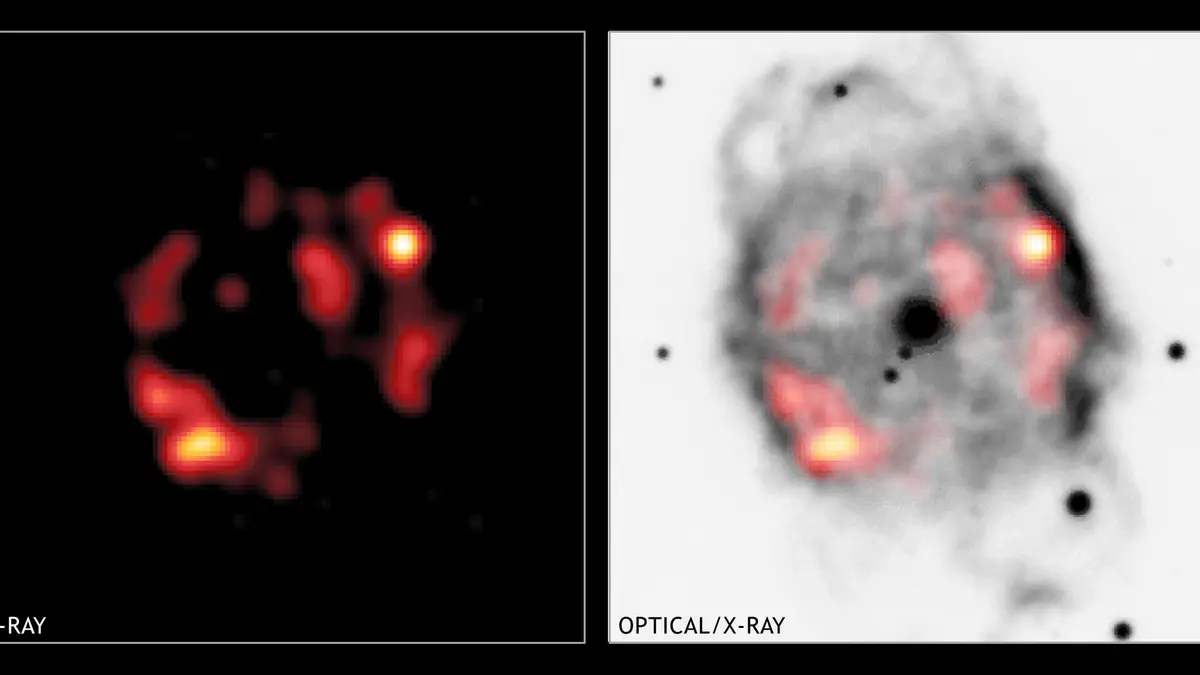
NGC 40 · planetary nebula
Bow-Tie Nebula
NGC 40 is a planetary nebula discovered by William Herschel on November 25, 1788, and is composed of hot gas around a dying star.
RA00h 13m 01sDec+72° 31' 18"
Identity & coordinates
Identification
- Primary designation
- NGC 40
- All designations
- NGC 40 · Bow-Tie Nebula
- Object type
- Planetary Nebula
- Constellation
- Cepheus
- Best viewing
- Autumn · Winter
Coordinates & physical
- Right ascension (J2000)
- 00h 13m 01s
- Declination (J2000)
- +72° 31' 18"
- Apparent magnitude (V)
- —
- Distance
- —
Visibility tonight
The science
NGC 40 is a planetary nebula discovered by William Herschel on November 25, 1788, and is composed of hot gas around a dying star. The star has ejected its outer layer which has left behind a small, hot star. Radiation from the star causes the shed outer layer to heat to about 10,000 degrees Celsius and become visible as a planetary nebula. The nebula is about one light-year across. About 30,000 years from now, scientists theorize that NGC 40 will fade away, leaving only a white dwarf star approximately the size of Earth.
Summary adapted from Wikipedia · CC-BY-SA-4.0
References
- SIMBAD Not resolved
- NED Fetched May 8, 2026 View in NED ↗
- Wikipedia Fetched May 8, 2026 Read full article ↗
1 merge conflict resolved
- coordinates: SIMBAD missing → NED used